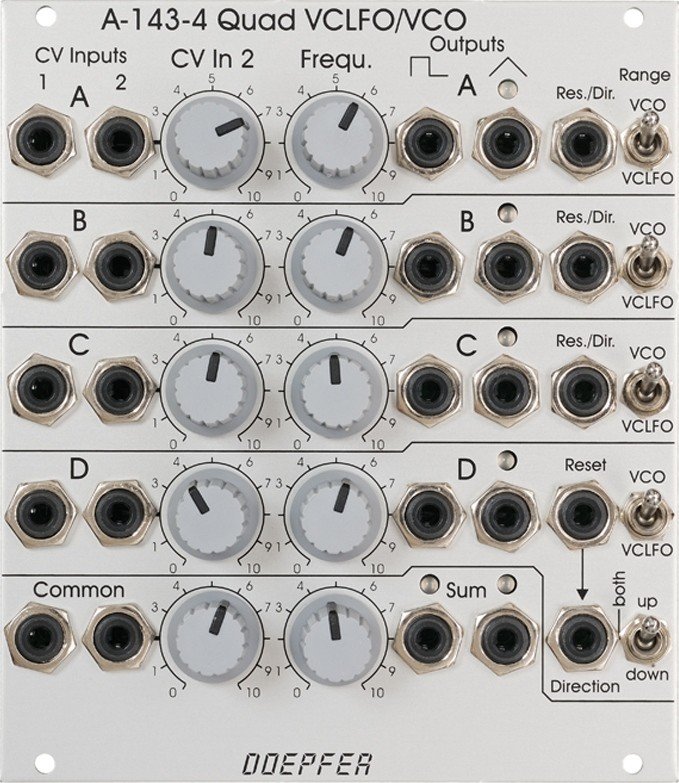


Doepfer A-143-4
CHF 239
Sur commande
Payer facilement avec :





Doepfer A-143-4
Module A-143-4 is a fourfold voltage controlled low frequency oscillator (LFO).
As the frequency range includes moderate audio frequencies it can be used as a four-fold VCO too.
Important Notes:
The module was planned mainly as a quad VCLFO. But we added a range switch (nothing but a switch for two different capacitors) so that even audio frequencies are possible and the module can be used as VCO with some restrictions too.
Because of the closeness of the main circuitry (i.e. four VCO cores within less ~ 1 square millimeter) the oscillators may lock if the frequencies are very close to each other. The reset circuitry is optimized for the LFO mode. As it takes some time to discharge the oscillator capacitor the discharge time had to be chosen so that the capacitor is fully discharged in LFO mode. In the high range (where a much smaller capacitor is used) this will cause a zero state duration in the 0.3 ms range if the oscillator is synced (during this time the capacitor is shortened for discharge).
The control scale of the inputs « CV1 » is about 1V/octave.
To improve the behaviour in the VCO mode a tempco circuit is used to keep the temperature of the exponential converter at a fixed temperature (similar to the tempco option of the DIY SYNTH).
That way the frequency of the VCOs (and even the VCLFOs) is nearly independent from the environment temperature. But the accuracy (1V/octave scale and temperature compensation) is not as precise as for the dedicated VCOs A-110 and A-111-1.
100 mA 12V ? mA -12V ? mA 5V 60 mm Depth
Vous avez des questions
Warranty Policy
Reliable support long after you buy.
Secure Payment
VISA, Mastercard and Apple Pay.
Produits qui pourraient vous intéresser :
-

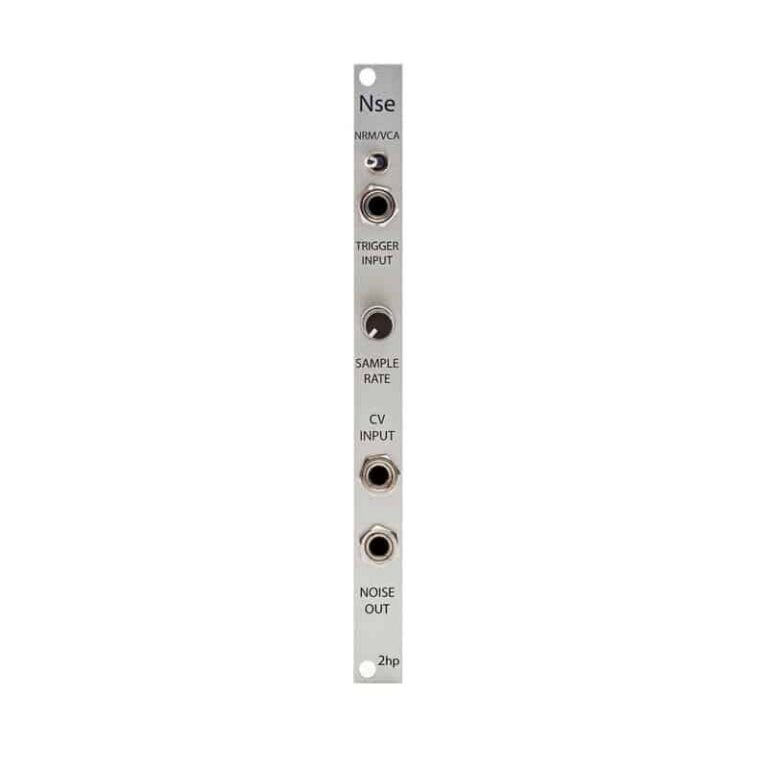
2 HP Nse
2 HP Nse Nse is a white noise generator.
CHF 165Sur commande -
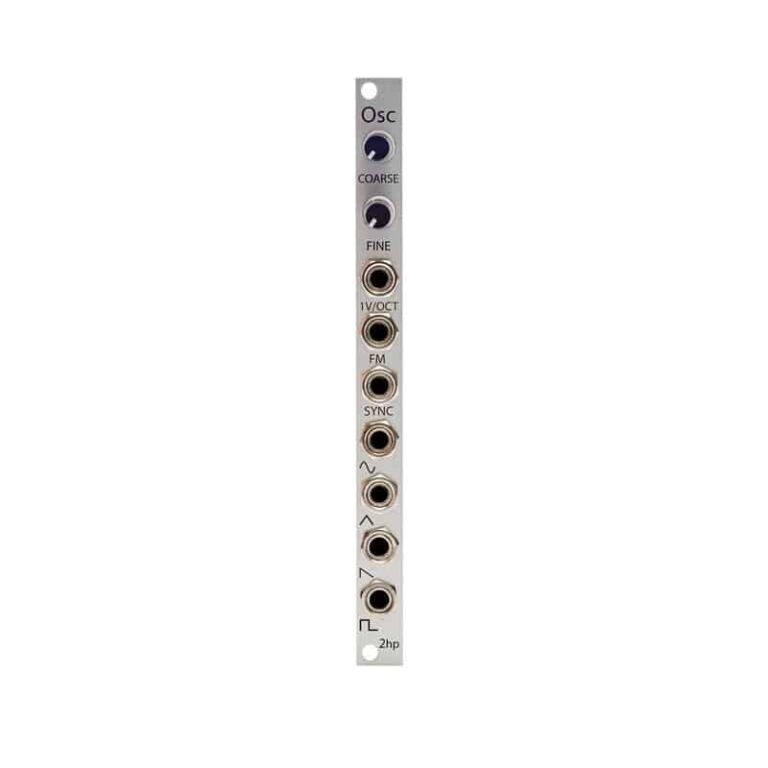
2 HP Osc
Osc is a voltage controlled, analog oscillator with an extremely wide frequency range.
CHF 165Sur commande -
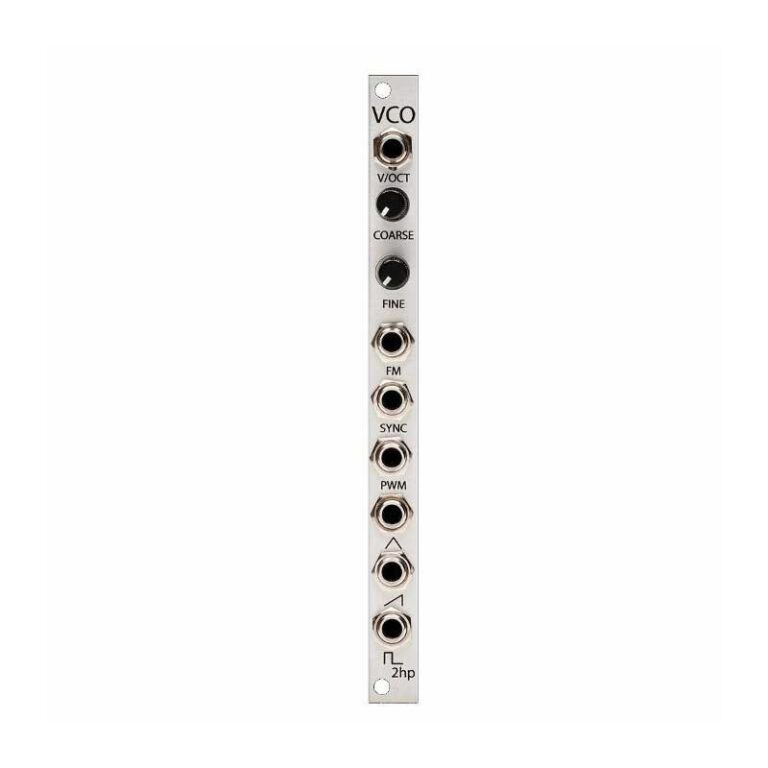
2 HP VCO
VCO is an analog voltage controlled oscillator based on the reissue of the legendary Curtis CEM3340 IC.
CHF 89En stock -
2HP Sine
2HP Sine Sine is a harmonically pure VCO with two distinct outputs. The primary output contains a perfect sine wave with a wide frequency range and pristine volt per octave tracking. The Sub output features two sine tones that can be blended together to achieve a mix of one octave below, or a fifth above…
CHF 154Sur commande